
Colorado Housing Market Forecast 2026: Current Market Data
Introduction
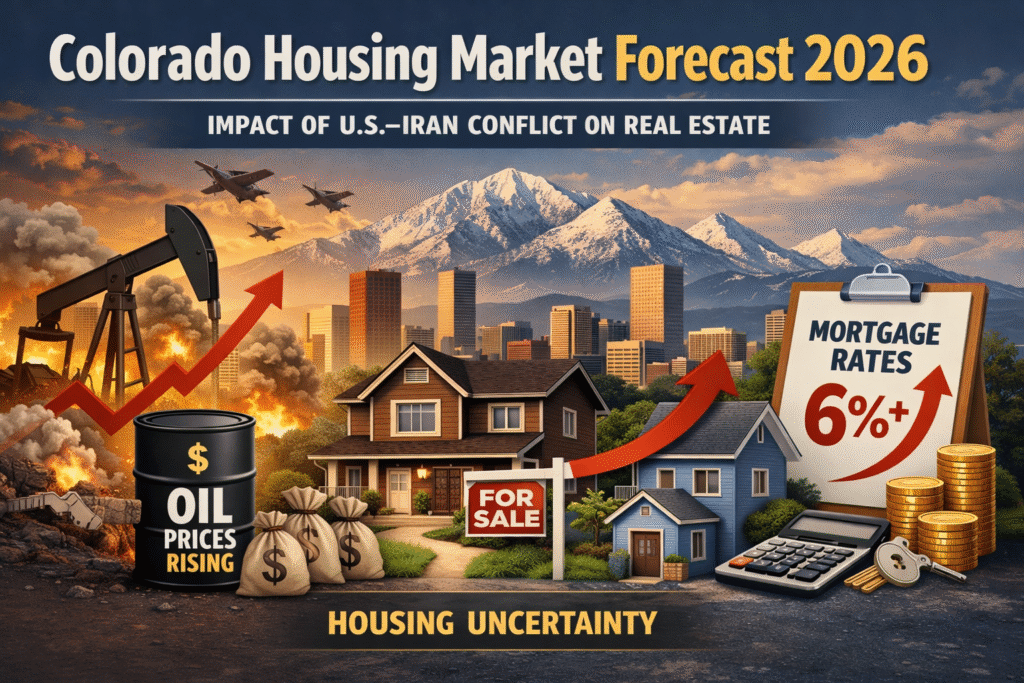
Colorado housing market forecast 2026 shows how global geopolitical conflicts create ripple effects across financial markets, energy prices, and housing affordability. The recent tensions involving the United States and Iran have contributed to volatility in global oil markets, inflation concerns, and mortgage rate fluctuations.
While Colorado is geographically distant from the Middle East, international economic shifts can still influence local housing markets, construction costs, and buyer demand. Understanding how these global dynamics affect real estate can help buyers, sellers, and investors make informed decisions.
Rising Oil Prices and Their Impact on the Colorado Housing Market Forecast 2026
Energy markets are one of the first areas affected during geopolitical tensions, especially when the conflict involves regions that play a major role in global oil supply.
According to the U.S. Energy Information Administration (EIA), geopolitical instability in oil-producing regions can significantly disrupt supply and lead to price spikes in crude oil markets.
Source: https://www.eia.gov/outlooks/steo/
Similarly, the International Energy Agency (IEA) notes that conflicts affecting Middle Eastern supply routes can quickly drive global oil prices upward due to fears of supply disruptions.
Source: https://www.iea.org/reports/oil-market-report
Why energy prices affect real estate
Higher oil and energy prices increase housing costs through several channels:
- Higher transportation costs for construction materials
- Increased contractor fuel expenses
- Rising utility and heating costs for homeowners
Colorado homes—particularly in colder mountain regions—often require significant heating during winter months, making energy costs a key factor in homeownership.
Additionally, construction projects rely heavily on fuel-powered equipment and transportation logistics. When energy prices rise, developers may experience increased costs for:
- Steel and concrete transportation
- Lumber delivery
- Heavy machinery operation
- Construction labor logistics
These rising costs can sometimes slow new housing developments.
Mortgage Rates and the Colorado Housing Market Forecast 2026
Mortgage rates are closely tied to broader economic conditions, including inflation and government bond yields.
The Colorado housing market forecast 2026 is closely tied to interest rate trends and inflation expectations.
According to Freddie Mac, the average 30-year fixed mortgage rate in the United States has recently hovered around 6%, following volatility tied to inflation and Federal Reserve policy.
Source: https://www.freddiemac.com/pmms
The Federal Reserve Bank of St. Louis also notes that mortgage rates tend to increase during periods of inflation and economic uncertainty, which can be influenced by global geopolitical events.
Source: https://fred.stlouisfed.org/series/MORTGAGE30US
How this affects Colorado buyers
Small increases in mortgage rates can significantly impact monthly housing payments.
| Home Price | Interest Rate | Monthly Payment |
|---|---|---|
| $550,000 | 5.8% | ~$3,230 |
| $550,000 | 6.2% | ~$3,360 |
Even small changes in interest rates can reduce affordability for buyers in competitive markets like Denver, Boulder, and Fort Collins.
Disclaimer: Payment examples are for illustrative purposes only and are not a rate quote or financial advice.
Current Colorado Housing Market Data (2026)
Despite global economic uncertainty, the Colorado housing market forecast 2026 shows continued long-term resilience.
According to Zillow’s Housing Data, the average home value in Denver is approximately $520,000.
Source: https://www.zillow.com/home-values/11093/denver-co
The Colorado Association of REALTORS® reports that housing inventory has been gradually increasing.
Source: https://coloradorealtors.com/market-trends
The U.S. Census Bureau indicates continued population growth in Colorado, supporting housing demand.
Source: https://www.census.gov/quickfacts/CO
What this means
These trends suggest the market is shifting toward a more balanced environment, where buyers may have slightly more negotiating power.
Construction Costs and Housing Supply in Colorado
Housing supply in Colorado is influenced by construction costs.
According to the National Association of Home Builders (NAHB), increases in fuel prices and material transportation costs can raise the overall price of building new homes.
Source: https://www.nahb.org/news-and-economics/housing-economics
Higher costs for:
- Fuel
- Building materials
- Labor logistics
- Equipment operations
may slow new development.
Key growth areas include:
- Denver metropolitan area
- Colorado Springs
- Northern Front Range
If construction slows while population growth continues, housing supply may tighten.
Investor Behavior and the Colorado Housing Market Forecast 2026
During periods of geopolitical uncertainty, investors often move capital toward long-term assets.
Colorado remains attractive due to:
- Population growth
- Strong job market
- High quality of life
- Diverse industries
These fundamentals support long-term demand in the Colorado housing market forecast 2026.
What This Means for Buyers and Sellers in 2026
For buyers
- Mortgage rates may remain around 6%
- Inventory has increased
- Negotiation opportunities may improve
For sellers
- Homes may stay on the market longer
- Pricing strategy is critical
- Well-prepared listings may perform better
Colorado Housing Market Forecast 2026: Possible Scenarios
Scenario 1 – Short-term conflict
- Oil prices stabilize
- Mortgage rates decline slightly
- Buyer demand increases
Scenario 2 – Prolonged geopolitical tensions
- Energy prices remain elevated
- Inflation persists
- Mortgage rates stay above 6%
Conclusion
The Colorado housing market forecast 2026 shows that even distant global conflicts can influence local real estate conditions. Rising energy prices, inflation pressures, and mortgage rate fluctuations all affect affordability and development.
However, Colorado’s strong economic fundamentals, population growth, and lifestyle appeal suggest continued long-term demand.
Staying informed about both global and local trends can help buyers, sellers, and investors make smarter real estate decisions.
Thinking About Buying or Selling in Colorado?
The Colorado housing market forecast 2026 shows changing conditions that can impact timing, pricing, and strategy.
✔ Get a customized home value
✔ Explore available listings
✔ Understand your buying power
📞 Schedule a consultation today and make informed real estate decisions.